
Deco Diamonds RTP: the qualified answer
Genting's listing for the original Deco Diamonds gives an RTP of 96.03% and names Just For The Win as the producer. That is the documented value attached to that operator listing when checked for this article on 2 November 2026. It is not proof that every operator, market or later edition uses the same configuration. Before using the number, match the exact game title and read the information panel in the client you are actually assessing. The missing word in many RTP comparisons is “which”.
The studio's own interview identifies Deco Diamonds as one of its games, providing a second source for the identity. A separate Betfred release note names Deco Diamonds Elite as another title. Do not remove a suffix from a lobby name and assume the remaining words identify the same mathematical product. This article concerns the original Deco Diamonds listing. It does not assign an RTP to Deluxe, Elite or an unverified operator configuration. Their rules must be checked independently.
Identify the game before comparing percentages
Record the complete title, studio credit, operator, date, device or client and any version identifier exposed by the rules panel. Include the jurisdiction if it is stated. A lobby thumbnail can help locate a title, but it is weak evidence of the payout configuration. Likewise, a distributor name in one catalogue and a studio name in another need not mean the games differ. Preserve both labels and establish what each describes rather than resolving the difference by guesswork.
Open the help, paytable or information panel before staking money. Note the displayed theoretical RTP, whether the figure applies to the whole game or a component, and whether separate modes have separate values. We have not inspected the user's game client, so its active configuration remains unknown. If a value is absent or contradicts the operator listing, retain the discrepancy and ask for the rules corresponding to that exact client. A review site's repeated number cannot settle the question.
What 96.03% means in monetary terms
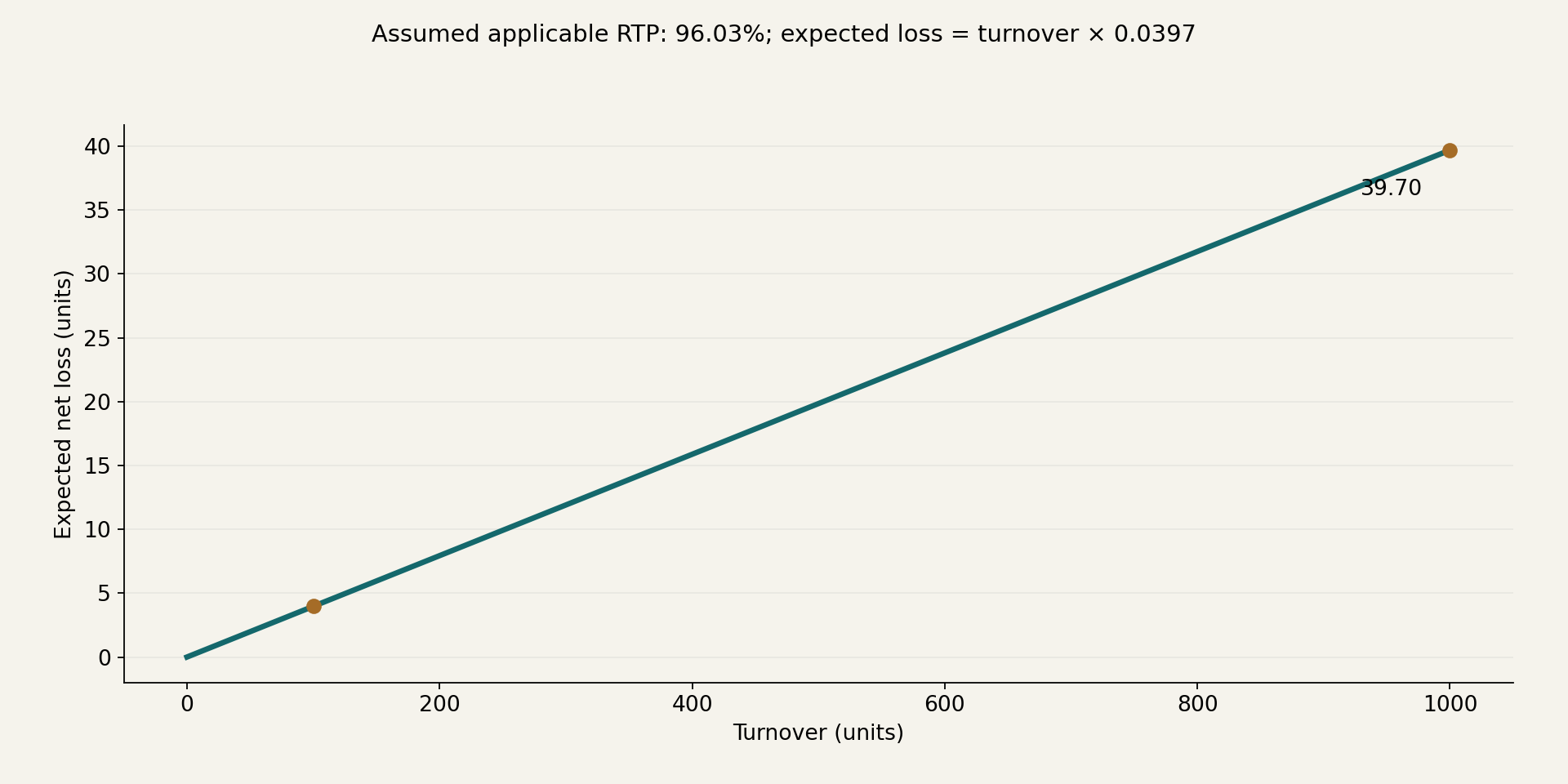
If the applicable theoretical RTP is 96.03%, expected gross payouts equal 0.9603 times total stakes. Expected net loss equals 0.0397 times total stakes, a theoretical house edge of 3.97%. These are long-run expectations under the applicable game rules. They are not a schedule of deductions, a guaranteed minimum payout or a prediction that an individual balance will decline smoothly. The outcome distribution can include long stretches with little returned and occasional much larger payouts.
A stake is counted every time it is wagered, including when earlier winnings fund another spin. A 100-unit deposit can therefore support more than 100 units of turnover. Deposit size alone does not determine theoretical gambling cost. Use the sum of accepted stakes, not the amount transferred to the account. Returned stakes and prizes belong in gross payouts; deposits, withdrawals and transfers do not. If bonuses or non-cash balances are involved, keep their accounting distinct rather than treating every balance movement as a normal game payout.
| Turnover | Expected gross payouts | Expected net loss |
|---|---|---|
| 100 | 96.03 | 3.97 |
| 1000 | 960.30 | 39.70 |
| 10000 | 9603.00 | 397.00 |
A worked turnover example
At a constant 0.50-unit stake, 200 spins create 100 units of turnover. At 96.03% theoretical RTP, the expected loss on that planned turnover is 3.97 units. A 1.00-unit stake over the same number of spins doubles turnover to 200 units and expected loss to 7.94 units. Neither example says the balance can necessarily finance all planned spins: a finite account can run out earlier. These calculations condition on the stated total turnover being completed.
Reusing wins is the reason the distinction matters. Suppose a balance starts at 20 units and, through repeated staking and payouts, completes 100 units of total bets. The expected cost formula uses 100, not 20. Conversely, depositing 100 units but stopping after ten one-unit spins produces ten units of turnover, not 100. More available money is not already wagered money. This accounting point explains why an apparently small stake can still generate substantial exposure during a long session.
Actual RTP is a different calculation
For a settled dataset, actual RTP equals total gross payouts divided by total stakes, multiplied by 100%. Consider two invented blocks: the first has 100 units staked and 80 paid out; the second has 900 staked and 900 paid out. Their individual returns are 80% and 100%, but the combined return is 980 / 1,000 = 98%. Averaging the two percentages to obtain 90% incorrectly gives a small block the same weight as a much larger one.
Those blocks are arithmetic examples, not Deco Diamonds observations. A personal actual RTP can be below or above the theoretical value without changing the configured return. To evaluate a discrepancy statistically, you need stake-weighted outcomes, sample size and information about variability. The UK Gambling Commission's live monitoring guidance explicitly makes volatility relevant and warns against aggregation that conceals differences between versions or channels. That guidance explains a measurement principle; it does not certify this game or operator.
Why a short session cannot verify the listing
Knowing only an RTP gives the mean, not the distribution of payouts. Two games can share the same theoretical return and have very different frequencies of small wins, bonus entries and rare large awards. We have not obtained a complete probability table for this specific game version. There is therefore no defensible spin count or confidence interval on this page for proving that Deco Diamonds returns exactly 96.03%. A precise-looking sample recommendation would require information we do not have.
The same limitation applies to “due” wins. A disappointing session does not create a debt that the next session must repay. Nor does an unusually high personal return demonstrate that a favourable configuration has been discovered. A record can establish what happened to that account over a defined set of settled bets. It cannot, by itself, identify the full game model, distinguish every possible configuration or forecast the next spin. Keep observation and inference in separate columns.
Compare versions without inventing a profile menu
Genting's 96.03% figure is a source-specific answer for the original title. The existence of a title called Deco Diamonds Elite establishes a naming distinction; it does not establish its RTP, volatility or a user-selectable switch inside the original game. We have not verified a full catalogue of RTP profiles for Deco Diamonds. Do not turn an operator discrepancy into an assertion that players can choose a return setting, or import a value from another edition because the artwork looks similar.
If two sources disagree, first check whether they refer to the same full title, market, client and date. Then distinguish theoretical RTP from an operator's historical actual return. An old monthly results table can be genuine while answering a different question from the current rules panel. Preserve the source context with the percentage. Without it, a comparison can look mathematically exact while comparing unrelated quantities. Where the client cannot be identified, the appropriate conclusion is unresolved configuration, not a guessed average.
Build a record another person can check
A useful evidence note contains the full title, studio or distributor label, operator, rules-panel wording, displayed RTP and date. Save a screenshot of the relevant panel where permitted, without account identifiers or payment details. A URL alone may later point to a changed listing. If the panel includes a game ID or version, copy it exactly. Record a missing field as unknown; an empty field should never be converted into a zero-percent return or a claim that no such information exists anywhere.
For a personal results ledger, store accepted stake, gross settled payout, currency and settlement status for each bet. Mark voids and unresolved transactions separately. If stakes vary, aggregate money before calculating the return. Avoid combining demo credits, bonus balances and cash balances without explaining the conversion rules. That creates a record useful for reconciliation and support. It still does not turn a small sample into an independent audit of the game's probability distribution.
A practical decision after the check
The next action is to compare the exact client with the sourced identity, not to search for a betting progression. If the applicable return is confirmed as 96.03%, use the 3.97% theoretical edge to understand the cost of turnover. Choose any spending and time limits before play, and reduce turnover if the projected exposure exceeds the amount you are willing to spend. No arrangement of stake sizes shown here creates a positive expected return from a negative-expectation game.
The accompanying chart is a deterministic calculation, not a payout forecast. Its straight line describes expected loss for stated turnover under a fixed assumed return. An individual balance will not follow that line, and the line does not describe volatility, the chance of bankruptcy or the time until a bonus. The documented conclusion is narrower and useful: one original-game listing reports 96.03%, its identity is corroborated by the studio, and any other version needs its own evidence.